Are dynamic grid fees just a theoretical concept for the future – or already an effective tool for a more efficient energy system?
The co-innovation project Grids and Benefits provided the answer: Over several months, dynamic grid fees were tested under real conditions – with measurable effects on grid stability and customer costs.
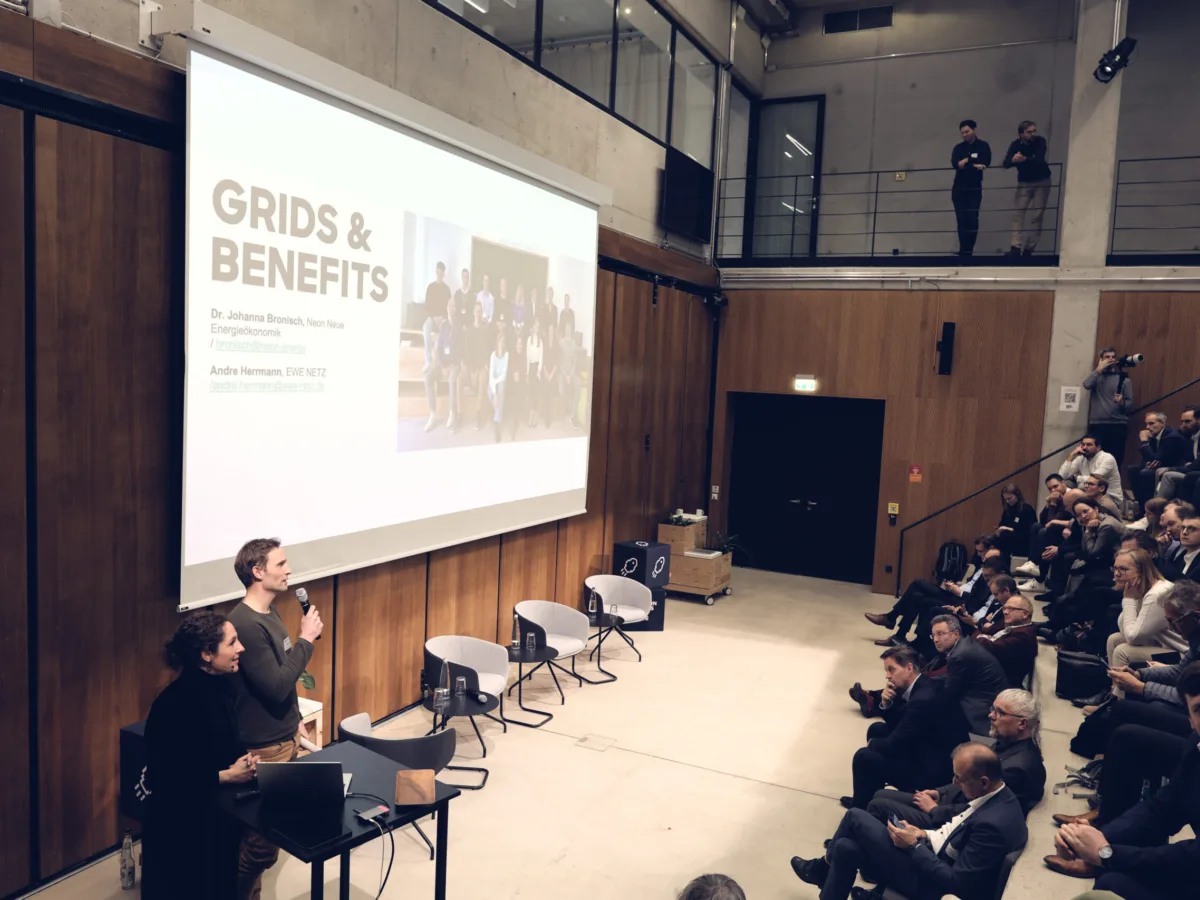
At the closing event on January 29 at Munich Urban Colab, around 150 experts from the energy industry, politics, and research discussed the role dynamic grid fees can play in a powerful, affordable, and climate-neutral energy system.
An Energy System in Transition
The talks from market and industry made clear how fundamentally the energy system is changing.
Bastian Gierull, CEO of Octopus Energy, spoke of an “iPhone moment” for the energy transition: Technologies are becoming increasingly affordable, while electrification and the expansion of renewable energy are progressing exponentially.
Dominik Becks, Global Head of Corporate Strategy – Business Development Energy, Circular Ecosystems at the BMW Group, showed how flexibility in customers’ homes can be put to concrete use – from smart charging of electric vehicles to bidirectional charging and bundling flexibility in so-called power pools.
From the perspective of transmission system operators, Dr. Markus Binder, CFO of TenneT, emphasized the scale of the upcoming investments. Flexible grid fees, he said, are a key lever for unlocking efficiency potential and enabling an energy system that is not only sustainable but also economically viable.
Why Dynamic Grid Fees Matter Now
Power grids are under growing pressure: The expansion of renewable energy and the increasing electrification of mobility and heating are creating new load peaks and bottlenecks. Redispatch costs already amount to around EUR 3 billion per year – and are set to rise unless effective incentives for grid-friendly behavior are created.
This is exactly where dynamic grid fees come in: They reflect the current state of the grid and create economic incentives to use electricity when it is particularly favorable from a grid perspective.
The Field Test: Flexibility in Real Operation
In the Grids and Benefits project, a strong consortium tested this approach systematically in real operation for the first time. Dynamic grid fees mapped the state of the grid and were applied automatically in a field test with more than 6,500 charging sessions.
The results clearly show the potential of flexible price signals:
Around 70 percent of home charging sessions were shifted to grid-friendly times.
Participating customers saved an average of 2 cents per kilowatt hour, and at peak times up to 10 cents per kilowatt hour.
Public charging also showed an effect: Price reductions of 20 cents per kilowatt hour or more led to measurably grid-friendly charging behavior – but only when drivers were able to respond actively.
Outlook: From Testing to Regulation
The project’s results provide important empirical insights for the further development of the regulatory framework. They feed into the ongoing discussion on the Federal Network Agency’s grid fee reform and aim to contribute to a practical, nationwide introduction of dynamic grid fees.
On February 9, Grids and Benefits and the project results will be presented in a webinar for the press and anyone interested.
If you’re interested in actively shaping the energy transition through co-innovation, you’re welcome to get in touch with Veronika Brandmeier (veronika.brandmeier@unternehmertum.de) and the UnternehmerTUM Energy team.
Photo: Steffen Kastner / UnternehmerTUM