Presented by
These insights are collected and presented by UnternehmerTUM - the leading center for innovation and business creation in Europe with over 20 years of experience in the development of innovation strategies and the implementation of technology-driven business ideas.
 © Bert Willer
Forum UnternehmerTUM 2024 - an annual invite-only event for changemakers and international visionaries sparks action for a liveable future
 © Steffen Kastner
Prof. Dr. Helmut Schönenberger (CEO, UnternehmerTUM) and Dr Robert Habeck, Federal Minister for Economic Affairs and Climate Action
 © Bert Willer
Ultimate Demo Day, powered by various UnternehmerTUM subbrands and partners, provides a platform to connect with the most promising cutting-edge start-ups right now
 © Alexandra Beier
UnternehmerTUM Corporates & Investors Casino Night brings together the forward-thinkers and decision-makers shaping the future of innovation, fostering meaningful connections and exchange
 © Bert Willer
Our events feature a diverse lineup of speakers: Jonas Deichmann, a German adventurer and record-breaking extreme athlete, captured at the Ultimate Demo Day 2022
How Start-up-Collaborations Address Technological Leaps
In the age of constant change and technological advancements, the term "Outside-In Innovation" is increasingly becoming a buzzword for companies seeking fresh approaches to stay competitive and continue to evolve. Outside-in innovation refers to the approach of using external knowledge, capabilities, and skills to initiate and accelerate internal innovation processes. Statistics reveal, that on average, firms direct 70% of their innovation budget to core enhancements, 20% to adjacent innovation, and 10% to disruptive projects.¹¹
Start-ups play a central role as a source of novel ideas, agile working methods, and disruptive technologies. In certain industries, collaboration is seen as a crucial form of staying in the game: in the aerospace industry, 100% of corporates have already collaborated with start-ups.⁷
Start-ups are not just shaking things up; they are practically leading the charge. Take the burgeoning metaverse ecosystem as an example: With 1,385 emerging metaverse start-ups identified in 2023, including major players like Meta, Qualcomm, and Microsoft actively investing in metaverse technologies, there's a real anticipation for the potential transformative impact of virtual worlds.²
Despite the term “metaverse” itself losing its shine in the past year (Apple’s product announcement for Vision Pro didn’t use terms “metaverse” even once), same innovation area keeps its interest with new terms such as “spatial computing” and "three-dimensional user interface". ³ ⁶
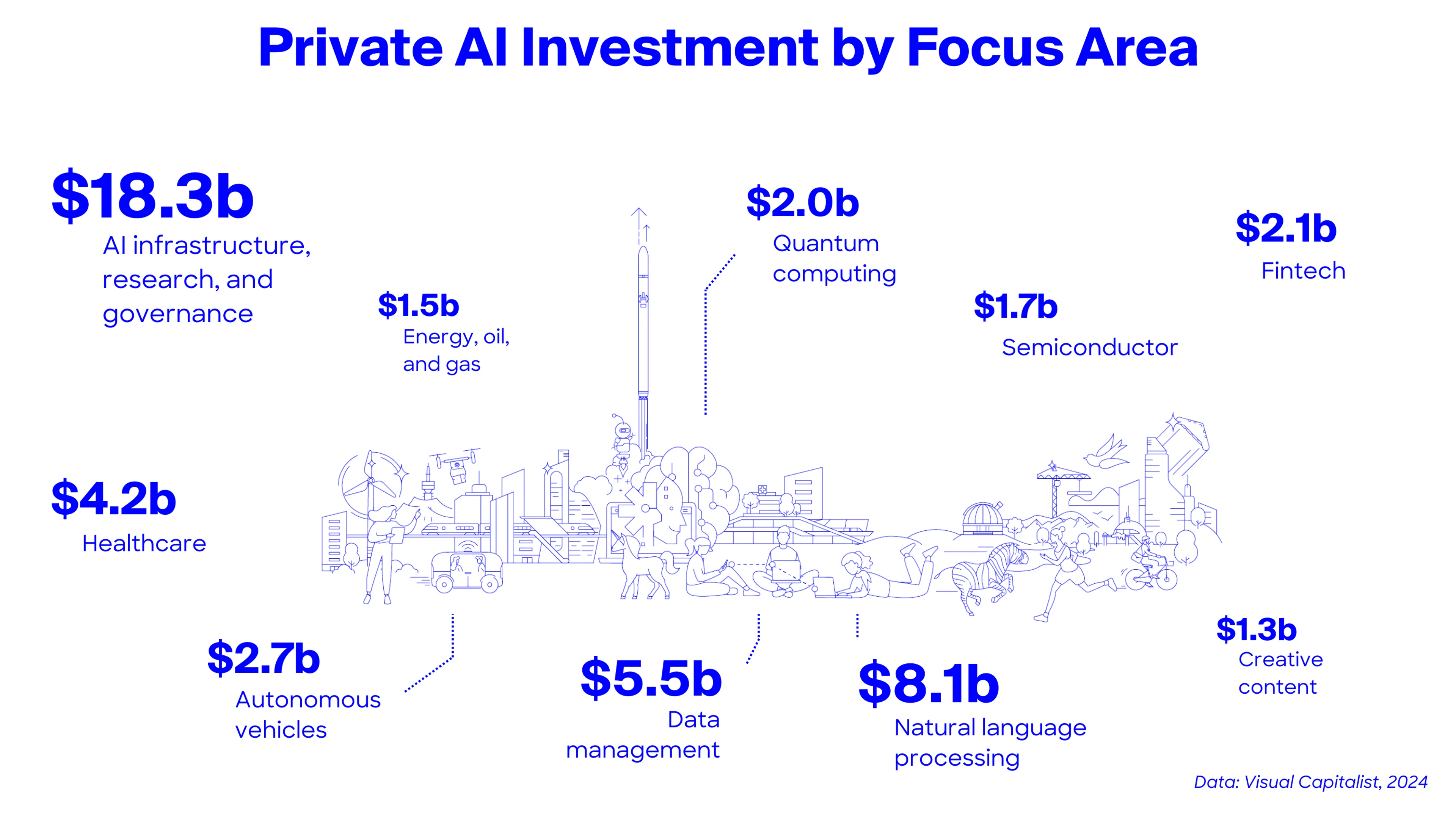
The desire to explore unknown business opportunities ranks as the foremost objective driving corporates to engage with start-ups. Sustainability, Artificial Intelligence, and Cybersecurity are the top three areas corporates aim to explore in collaboration with start-ups.⁷
AI and Big Data alone accounted for nearly a third of global VC-funded start-up deals in 2022, underscoring the critical role of these technologies in transforming industries and unlocking new market opportunities.¹⁷
Over in the DACH region, start-ups are making waves, especially in AI; Generative AI start-ups in the region have seen a surge in funding, surpassing previous records, while overall VC funding levels have returned to pre-2021 levels.⁴
In 2023 alone, a total of 341 AI-related start-ups were founded, corresponding to a rise of 67% compared to the previous year.¹⁶ The number of German unicorns has shot up (quadrupled in the last five years) - but there's still some catching up to do with the big guns like Israel and the USA.⁵
Number of newly funded AI start-ups 2013-2023 ¹⁵
The Blueprint of a Successful Collaboration
Successful collaboration between SMEs and start-ups requires a clear structure and a strategic approach. Here are three key principles to establish a rock-solid foundation for a powerful and effective partnership.

Management Commitment and Establishment of KPIs
Management commitment and support are crucial to the success of a collaboration with start-ups. It is important that management recognizes the importance of these partnerships and is actively committed to them. This can take the form of financial support, provision of resources and the setting of clear goals and key performance indicators (KPIs). By setting KPIs, the progress and success of the collaboration can be measured and evaluated, enabling continuous improvement.

Understanding the own Company as a Service Provider for the Start-up
To create a win-win situation, SMEs should view their company as a service provider for the start-up. This means that they don’t only provide a budget, but also make their expertise, experience and resources available. This can help start-ups to implement their ideas more quickly and accelerate their growth. It is also important to make clear agreements and contracts about the collaboration to define and document the expectations of both sides.

Supporting Consciousness within the Company about the Collaboration
Companies must foster awareness and acceptance across all levels. This involves proactive communication about collaboration goals, engaging relevant business units from the outset, and ensuring that employees understand how the partnership impacts their work environment. Additionally, SMEs should avoid exclusivity with a single start-up and remain open to diverse partnerships for a broader range of ideas and innovations.
How we've connected the dots in Germany and beyond
 © Alliance, Imago
„So können wir nicht weitermachen“
Der Bundeswirtschaftsminister will bis zu 15 Start-up-Factories fördern. Dafür gibt es ein Vorbild – das von Helmut Schönenberger geleitete Gründungszentrum UnternehmerTUM.
Read More: Handelsblatt
 © The Innovator
How Cremer, A 78-Year-Old Business, Is Helping Food Startups Innovate
After sending its top executives through a program at UnternehmerTUM, Cremer, with its business unit DTC (Deutsche Tiernahrung Cremer) the largest privately owned provider of animal feed in Germany, decided to branch out into sustainable nutrition for humans.
Read more: https://theinnovator.news/how-...

Digital Reboot: How the Family Office PFAFF is Driving its Digitalization with UnternehmerTUM
The Bavarian family-owned enterprise PFAFF Werkzeug- und Formenbau looks back on a 60-year history of successfully manufacturing injection molds for sealing systems in the automotive industry and is one of the three most prominent global players in this niche market.
Read More: UnternehmerTUM
 © Stefan Muel
Im Mittelstand gibt es noch viele digitale Lücken
Familienunternehmen haben einen hohen Digitalisierungsbedarf. Die Münchner Start-up-Schmiede UnternehmerTUM will Abhilfe schaffen, auch mit Künstlicher Intelligenz.
Read more: https://www.faz.net/aktuell/wi...
3 Corporate-Start-up Success Stories
Partnerships and collaboration projects between established companies and global start-ups have catalyzed the creation of innovative products, enhanced customer experiences, and optimized quality control processes. Take a look at some of the examples from our ecosystem:

HP Tech Ventures & Simplifyber: Introducing The First-Ever Biodegradable Plant-Based Shoe
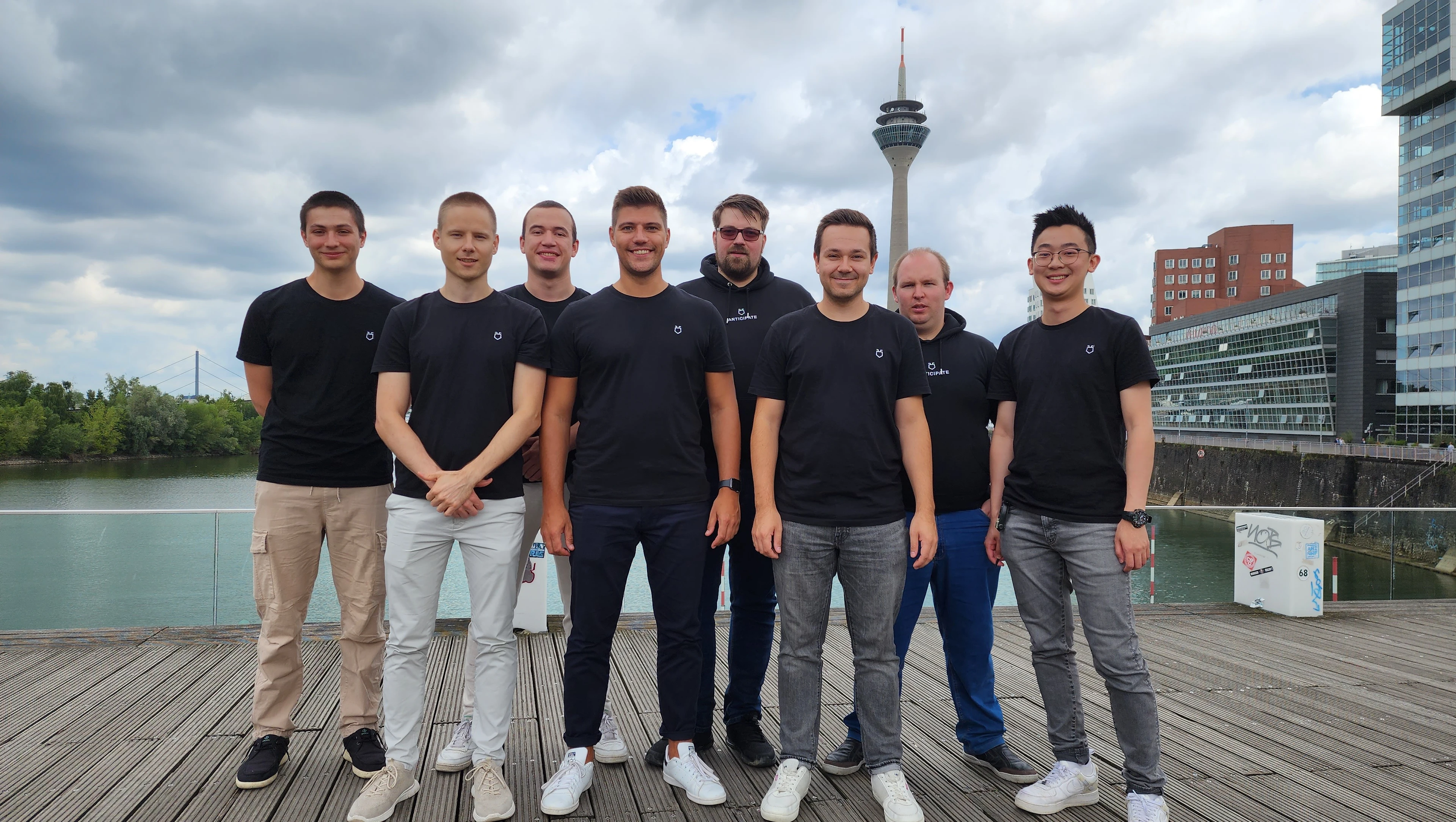
WACKER & ANTICIPATE: Enhanced Quality Control With AI-Powered Video Analytics

ADAC & VirtualQ: Over 300,000 Saved Waiting Minutes In Less Than Six Months
Unraveling the Causes of Partnership Failures
Lagging Enthusiasm in Germany - Has Berlin’s hype worn out?
Despite the growing number of Corporate-Start-up collaborations across Europe, significant challenges persist, particularly in Germany. While countries like Italy and the Benelux region exhibit the highest enthusiasm for open innovation (with 80% of the companies actively pursuing these initiatives), Germany lags behind with only 57% participation in such partnerships.⁷ This is notably low considering Berlin’s reputation as a leading European start-up hub. Collaboration between start-ups and established companies has fallen by 10 percentage points in the last three years and now stands at 61%. Only 28% of start-ups report satisfaction with corporate partnerships.¹² Corporate venture capital is also more restrained than in the previous year.⁵
So what is hindering Corporate-Start-up collaborations?
Despite 79% of companies ranking innovation as a top-three priority, only 6% of executives are satisfied with their innovation performance. Additionally, dissatisfaction with existing partnerships is a critical issue, with 45% of corporates and 55% of start-ups reporting being “very dissatisfied” or “somewhat dissatisfied” with their collaborative efforts.⁹ These results underscore the pressing need for the development of more effective innovation strategies and collaboration formats.

1. Lack of Clarity and Expectations
Corporate-Start-up collaborations often face challenges due to unclear objectives and unrealistic expectations. Companies may expect tailored solutions without considering start-up capabilities or implementation efforts. Meanwhile, start-ups prioritize access to the larger partner’s market. To succeed, a holistic approach that recognizes both sides’ needs is crucial.
2. Lack of Corporate Support
Only a few collaborations make it to fruition; just over 11% of Corporate-Start-up collaborations make it all the way to scaled deployment. These “would-be” collaborations are hampered along the way not only on the start-up side of the equation but also through a lack of corporate support. Only 37% of start-up respondents say that corporates have dedicated resources, budget, or a well-defined scaling process to drive start-up collaborations. ⁸
3. Legal & Regulatory Barriers
Legal and regulatory issues account for 14% of the incompatibility challenges between corporates and start-ups, creating significant hurdles that can stifle potential partnerships and innovative breakthroughs.⁷
4. Low Risk Tolerance & Legal Barriers
13.7% of companies cited the low risk tolerance as a reason for incompatibility with start-ups.⁷ Corporates often hesitate to embrace projects due to a reluctance to adopt uncertain or unconventional innovations, despite potential rewards. Evaluating financial and market risks against possible benefits can hinder their willingness to invest in and test new products or solutions. Additionally, sharing information with start-ups poses risks to proprietary knowledge, leading to potential intellectual property issues.
5. Prolonged Time to Go-Live
A critical issue emerges from the prolonged time required for collaborations to reach the go-live stage in Europe compared to other regions. This delay hampers the ability of both corporates and start-ups to swiftly capitalize on innovative opportunities, reducing the competitive edge that these collaborations are intended to provide.⁸
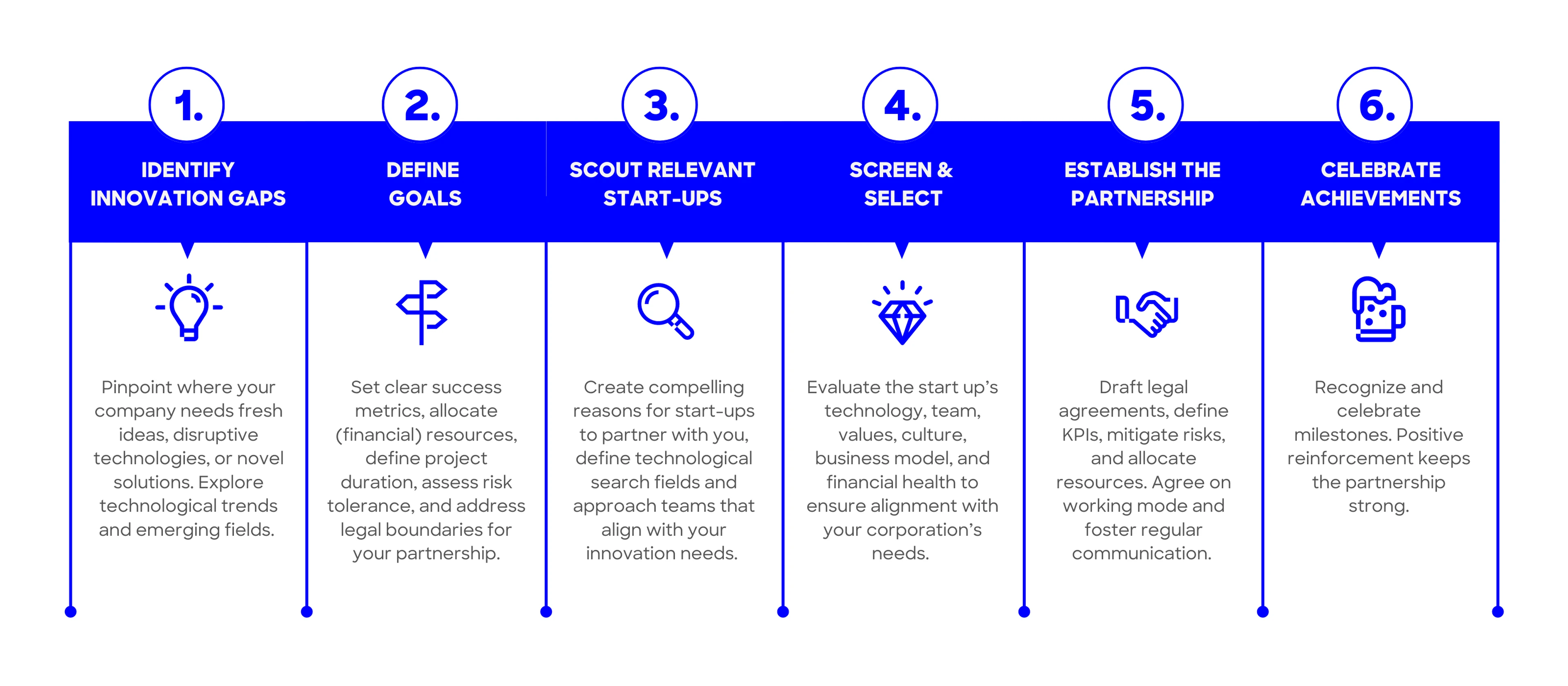
Achieving Corporate-Start-up Success: A Six-Step Guide
As we have seen throughout this page, these collaborations provide mutual benefits - start-ups obtain access to resources and market expertise, while corporations benefit from new ideas, agility, and technological advancements. However, while the potential benefits are significant, a number of obstacles can impede the success of these collaborations.
To ensure your company is equipped to overcome common challenges, we've compiled steps and a checklist for successful collaboration between your company and start-ups, maximizing the benefits for both parties. As mentioned above, leveraging third-party services which specialize in facilitating such collaborations, has been proven to enhance partnership outcomes. Consider using third-party accelerator or incubator programs, Corporate-Start-up matchmakers, or venture client partners to streamline your collaboration process.
For further information on how your start-up partnerships can be elevated or how to begin leveraging collaboration with start-ups to enhance your company's competitiveness, please contact our designated personnel listed at the end of this page.
Roadmap to Successful Collaboration Projects
Checklist for Thriving Corporate-Start-up Partnerships
✓ Set expectations & clear objectives early on
✓ Align a detailed roadmap at the beginning
✓ Clarify the type and scope of support you can provide
✓ Get access to the data you need from the start
✓ Clarify NDA and other legal matters
✓ Be honest and transparent about the budget and plan early
✓ Involve decision-makers in the process from day 1
✓ Clarify the tasks/duties of both parties
✓ Encourage a transparent and open dialogue
✓ Specify internal marketing promoter for the start-up
Turn these insights into impact: Contact Our Experts
Let’s Talk Innovation Strategy
UnternehmerTUM Business Creators combines methodological expertise with strategic implementation to drive innovation projects. Guided by business design principles, we leverage our extensive experience in problem identification and solution development to ensure long-term competitiveness
What we offer:
- Align corporate and innovation strategy and identify fields of innovation
- Discover customer needs and technologies and develop business ideas
- Validate new business models and implement them on the market
- Activate the core organization and empower innovators within the company
Let’s Talk Start-up Collaboration
TechFounders specializes in strategic partnerships between corporates and start-ups through various matchmaking formats. We prioritize addressing the unique needs of each corporate and start-up, focusing on maximizing the effectiveness of their collaboration.
What we offer:
Venture Clienting: Establish your in-house venture client unit or transform other innovation unit formats into a venture client unit
Pilot Project Program (Partnership): Low-risk validating the feasibility and potential impact of a start-up's solution without the need to operate your own in-house program.
Start-up Scouting for various purposes, including your own innovation challenges, with insights into the latest innovation market trends.