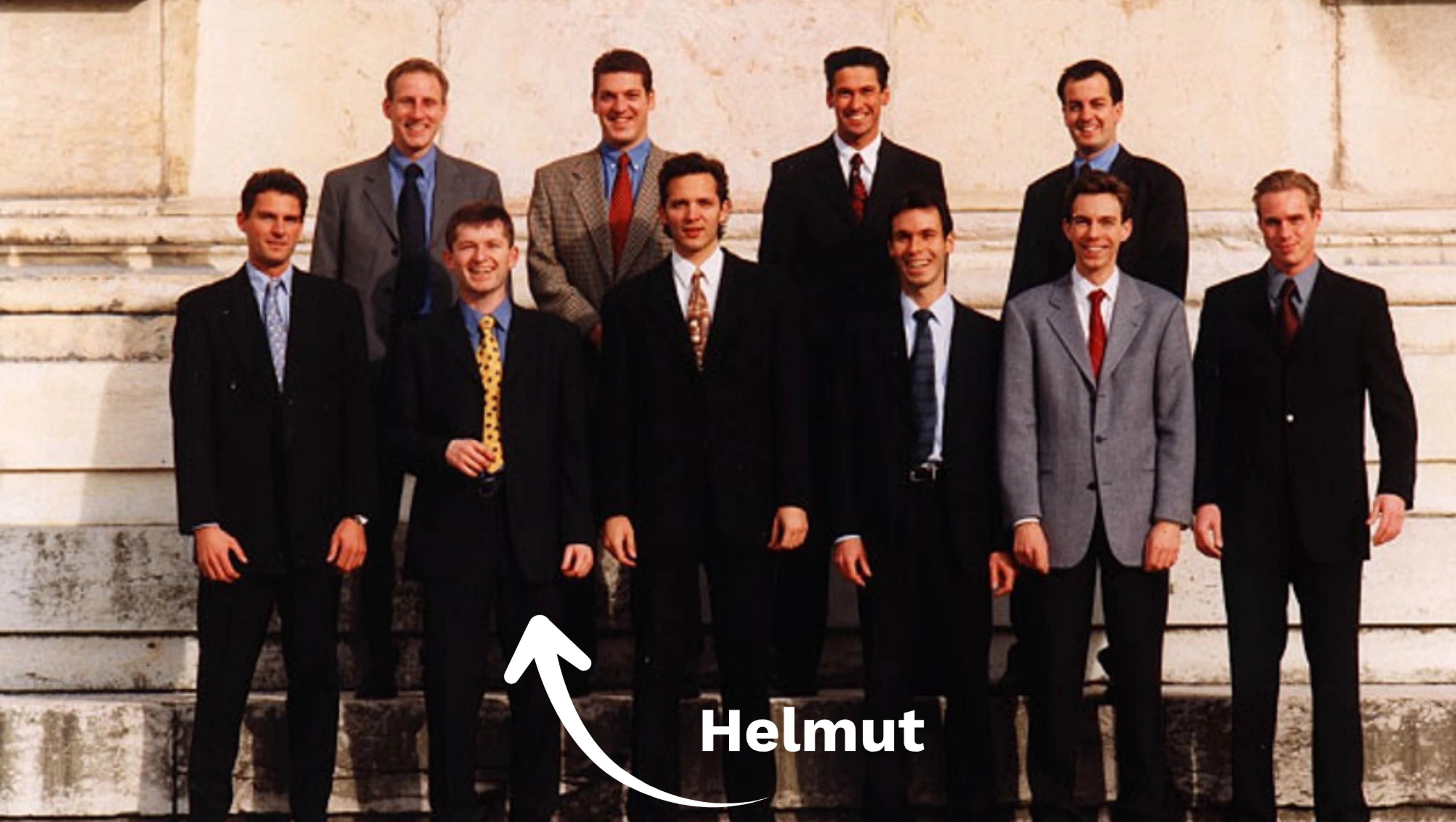
I have loved airplanes for as long as I can remember. As a schoolboy, I built model airplanes day and night, and when it became clear that I wanted to study, there was only one option for me: Stuttgart. In 1992, the University of Stuttgart offered the only degree program in aerospace engineering in Germany. I had no idea at the time where that path would lead me.
The First Day That Changed Everything
Sometimes the most important turning points happen in the most unremarkable moments. For me, it was the orientation session on my very first day at the University of Stuttgart. That day, the dean welcomed us first-year students with a speech I still remember today, followed by groups of students introducing themselves. One of them was EUROAVIA, a student initiative for aerospace students across Europe. On stage, they talked about a study trip and said: "On Wednesday, we're all driving to Toulouse to visit Airbus and meet the French students. We still have two spots left."
I raised my hand — and off I went.
I could not have asked for a better start to my studies. Heading to Airbus in France in my very first week was my entry into aerospace, but also into a European perspective that has stayed with me ever since.
The degree itself was demanding: a great deal of mathematics and physics. But alongside the required curriculum, I got involved in the student council and in initiatives like EUROAVIA. It was exactly this mix of rigorous training and personal initiative that shaped me. Would I do it again? Without hesitation. The technical understanding I gained there became the foundation for everything I do today. How do control systems work? How do you program? How do you build something? Today, I draw on that knowledge in a different setting, yet the underlying idea is often the same.
Next Stop: The Space Shuttle — Between Orbit and Insight
My path then led me to the University of California. Here, I had the chance to work on optimizing the Space Shuttle's flight path, together with NASA and McDonnell Douglas, then one of the world's leading aircraft manufacturers. Back then, in the mid-1990s, there were no powerful computers yet; everything was far more modest than today.
Our challenge was to calculate a trajectory that would bring the Shuttle safely back from orbit to Earth without overheating. A real optimization problem.
But the real lesson from that time came not from the technology, but from the conversations with the NASA engineers I worked with. Many of them, some 30 years older than me, had once worked on the Apollo moon landing program, and now complained about how difficult everything had become. Weighed down by more bureaucracy, less inspiration, and cumbersome ways of working, they had lost their fascination. I asked myself: why? And I knew one thing for certain: that is not how I want to end up after 30 years. I wanted to do something with passion.
Out of that moment, it became clear to me: technology alone is not enough; I also wanted to learn to think entrepreneurially. That is exactly what brought me to management.
The Leap to TU Munich — and a Bold Idea
In the late 1990s, the internet era began, and suddenly new technologies and companies were springing up everywhere, much like what we are experiencing today with artificial intelligence. A few of us students bought shares and became, at least on paper, millionaires overnight. That showed me there was so much more to come.
For the time being, I turned my back on the Golden State and, drawn by the new opportunities the 2000s were bringing, decided to pursue a management degree at the Technical University of Munich.
Still inspired by the US, I explored for my thesis how Stanford and Silicon Valley worked, and what TU Munich and the city of Munich could learn from them. The idea: to build an entrepreneurship center of our own.
I presented my proposals to the President of TU Munich at the time. His reaction has stayed with me to this day: "That's a really good idea, let's do it. But first, let's pitch the concept to Susanne Klatten, a great entrepreneur, and bring her on board, then we can get started."
We pitched. We succeeded. And here I am, 25 years later, still doing the same thing, as co-founder and CEO of UnternehmerTUM, today Europe's leading center for innovation and business creation, and still alongside Ms. Klatten, who continues to support us as shareholder and chair of the supervisory board.
What Really Moved Me Forward
When I look back, it was never just one thing that drove me, but always a combination. First, of course, you need your own energy and the will to go the extra mile, but you also need an environment of people you can learn from. Mentors who said: "Just do it." My control engineering professors in Stuttgart, in particular, sent me to the University of California in exactly that spirit.
That is precisely the support I want to give back today, to young people whose goal is to realize their vision and their life's dream.
One of the most formative moments at the University of Stuttgart, by the way, had nothing to do with technology. I still remember the day well. I was sitting in the lecture hall of my rhetoric seminar, shaking like a leaf, because I had to give my first talk. It took an enormous amount of courage, but I dared to do it. Today, I give talks several times a week, and I'm glad I pushed myself back then.
Telling my story here makes it sound as if everything in my career worked out on the first try. Surprise: it did not. I have also worked on projects that failed, developed ideas that did not work, and had conversations with potential customers that led nowhere. But that is exactly part of it, then as now. What matters is that enough succeeds overall to carry the failures too.
What I Want to Pass On to Students
When I look at young people starting their studies today, I see one thing above all: a spirit of new beginnings. Many of them bring exactly the right mix: curiosity, technical understanding, and the courage to go their own way. That is the real raw material for any venture. And once that spark jumps across, it gives others the courage to try as well.
A résumé with titles like Diplom-Ingenieur, honorary professor, founder, or CEO always looks very straightforward in hindsight. What you don't see are the experiments that didn't work, the curiosity, and the many small moments in which I simply summoned the courage to give it a try.
So if I could pass on just one thing to you:
Be bold and step out of your comfort zone. That is exactly where every journey worth taking begins.
Helmut Schönenberger, CEO & Co-Founder UnternehmerTUM
_______________________________________
This article is based on a conversation with Helmut Schönenberger in the first episode of the University of Stuttgart's alumni podcast, hosted by Rubina Breuer.